Estas son unas opciones para preguntar la hora en inglés:
1. What time is it?
2. What’s the time?
3. Have you got the time?
Páginas
TYPES OF ACCOMMODATION

The 16 major types of accommodation When you are travelling or working in the tourism industry, it is important to understand what the different types of accommodation are. Fortunately, the tourism industry is multifaceted an… Ir a este Sway
| The 16 major types of accommodation | |
| When you are travelling or working in the tourism industry, it is important to understand what the different types of accommodation are. Fortunately, the tourism industry is multifaceted an… | |
|
MODAL VERBS : CAN / COULD / MUST / SHOULD
CAN = Poder, saber hacer algo
I can speak English = Sé hablar inglés
I can't speak German = No sé hablar alemán
Can you hear me? = ¿Puedes oírme?
COULD = Podía, podría, pudo (Es el pasado de “can”)
He could run very fast = Él podía correr muy rápido
He couldn't play football last week = Él no pudo jugar al fútbol la semana pasada
Could you open the door? = ¿Podrías abrir la puerta?
MUST = Deber , tener que
En afirmativa e interrogativa expresa obligación.
They must go now = Ellos deben irse ya.
Must we do the homework? = ¿Debemos hacer los deberes?
En negativa expresa prohibición
You mustn't eat in class = No debes comer en clase
SHOULD = Debería, deberías, etc
En afirmativa se usa para dar y pedir consejos o para hacer sugerencias.
You should pay attention = Deberías atender
En negativa se utiliza para dar a entender que algo no nos parece buena idea.
You shouldn't smoke = No deberías fumar
CARACTERÍSTICAS:
1 – Utilizan la misma forma para todas las personas.
2 – Van seguidos de infinitivo sin “to”.
3 – En negativa añaden “not” o su forma breve al verbo.
4 – En interrogativa invertimos el sujeto y el verbo.
MODAL | EXAMPLES | USES |
CAN | He can find any street in London. You can take a taxi. Can you take me to Victoria Station? | Ability Suggestion Request |
BE ABLE TO | He is able to find any street in London. | Ability |
CAN ́T | That story can ́t be true. | Certainty that something is impossible |
COULD | I could play tennis when I was younger. Could you take me to Victoria Station?. You could take a taxi. | Ability Request Suggestion |
MAY | It may be quicker to travel by train. May I come in?. | Possibility Formal request |
MIGHT | It might be quicker to travel by train. | Possibility |
MUST | You must be back at 10 o ́clock. Look at the snow. It must be cold outside. | Obligation Certainty that something is true |
HAVE TO | You have to be back at 10 o ́clock. | Obligation |
NEED TO | You need to study a lot. | Obligation |
NEEDN ́T | You needn ́t have a university degree. | Lack of obligation |
MUSTN ́T | You mustn ́t drive without a licence. | Prohibition |
DON ́T HAVE TO | You don ́t have to call a taxi. | Lack of obligation |
SHOULD | You should drive more carefully | Opinion / Advice |
OUGHT TO | You ought to drive more carefully | Opinion / Advice |
On the images below, you'll find out more about them!
![]() |
| Click to start working! |
![]() |
| Click to start working! |
THE PAST SIMPLE
THE PAST SIMPLE
Informe: Past Simple vs Past Continuous
1. Past Simple (Pasado Simple)
- Uso principal:
- Acciones terminadas en el pasado.
- Eventos que ocurrieron en un momento específico.
- Palabras clave:
- yesterday, last week, in 2020, two days ago, when I was a child.
- Forma:
- Afirmativa: sujeto + verbo en pasado (+ complemento).
- Ej.: I visited the Guggenheim Museum yesterday.
- Negativa: sujeto + did not (didn’t) + verbo base.
- Ej.: I didn’t visit the museum.
- Interrogativa: Did + sujeto + verbo base + complemento?
- Ej.: Did you visit the museum?
- Reglas para verbos:
- Regulares: añadir -ed (visit → visited).
- Irregulares: forma especial (go → went, see → saw).
- Uso principal:
- Acciones terminadas en el pasado.
- Eventos que ocurrieron en un momento específico.
- Palabras clave:
- yesterday, last week, in 2020, two days ago, when I was a child.
- Forma:
- Afirmativa: sujeto + verbo en pasado (+ complemento).
- Ej.: I visited the Guggenheim Museum yesterday.
- Negativa: sujeto + did not (didn’t) + verbo base.
- Ej.: I didn’t visit the museum.
- Interrogativa: Did + sujeto + verbo base + complemento?
- Ej.: Did you visit the museum?
- Afirmativa: sujeto + verbo en pasado (+ complemento).
- Reglas para verbos:
- Regulares: añadir -ed (visit → visited).
- Irregulares: forma especial (go → went, see → saw).
2. Past Continuous (Pasado Continuo)
- Uso principal:
- Acciones en progreso en un momento del pasado.
- Describir contexto o acción interrumpida por otra.
- Palabras clave:
- while, when, at 8 o’clock yesterday.
- Forma:
- Afirmativa: sujeto + was/were + verbo + -ing.
- Ej.: I was walking along the river at 8 pm.
- Negativa: sujeto + was not (wasn’t)/were not (weren’t) + verbo + -ing.
- Ej.: I wasn’t walking at that time.
- Interrogativa: Was/Were + sujeto + verbo + -ing?
- Ej.: Were you walking along the river?
- Uso principal:
- Acciones en progreso en un momento del pasado.
- Describir contexto o acción interrumpida por otra.
- Palabras clave:
- while, when, at 8 o’clock yesterday.
- Forma:
- Afirmativa: sujeto + was/were + verbo + -ing.
- Ej.: I was walking along the river at 8 pm.
- Negativa: sujeto + was not (wasn’t)/were not (weren’t) + verbo + -ing.
- Ej.: I wasn’t walking at that time.
- Interrogativa: Was/Were + sujeto + verbo + -ing?
- Ej.: Were you walking along the river?
- Afirmativa: sujeto + was/were + verbo + -ing.
3. Diferencia clave
- Past Simple: acción terminada → I visited Bilbao last summer.
- Past Continuous: acción en curso → I was visiting Bilbao when it started to rain.
- Past Simple: acción terminada → I visited Bilbao last summer.
- Past Continuous: acción en curso → I was visiting Bilbao when it started to rain.
4. Ejemplos turísticos
- Past Simple: We booked the hotel last week.
- Past Continuous: We were checking in when the manager arrived.
- Past Simple: We booked the hotel last week.
- Past Continuous: We were checking in when the manager arrived.
LIST OF IRREGULAR VERBS
LA HORA EN INGLÉS
Find a lesson via Quizziz HERE!
Preguntar la hora:
Decir la hora:
Para dar la hora podemos usar una de las siguientes expresiones:
1. The time is three o’clock.
2. It’s three o’clock.
3. Three o’clock. (sólo dar la hora)- Set the clock: ajustar el reloj, cuadrar el reloj.
- What time is it?: ¿qué hora es?
- What time is the meeting?: ¿a qué hora es la reunión?
- What time is the lesson?: ¿a qué hora es la lección?
- In the morning: en la mañana.
- In the afternoon: en la tarde.
- For half an hour: por media hora.
- For an hour: por una hora.
- Minutes: minutos.
¿Queda entendido? Pues vayamos a la sección "HOMEWORK" y practiquemos.
Para dar la hora podemos usar una de las siguientes expresiones:
1. The time is three o’clock.
2. It’s three o’clock.
3. Three o’clock. (sólo dar la hora)
1. The time is three o’clock.
2. It’s three o’clock.
3. Three o’clock. (sólo dar la hora)
DESTINATIONS
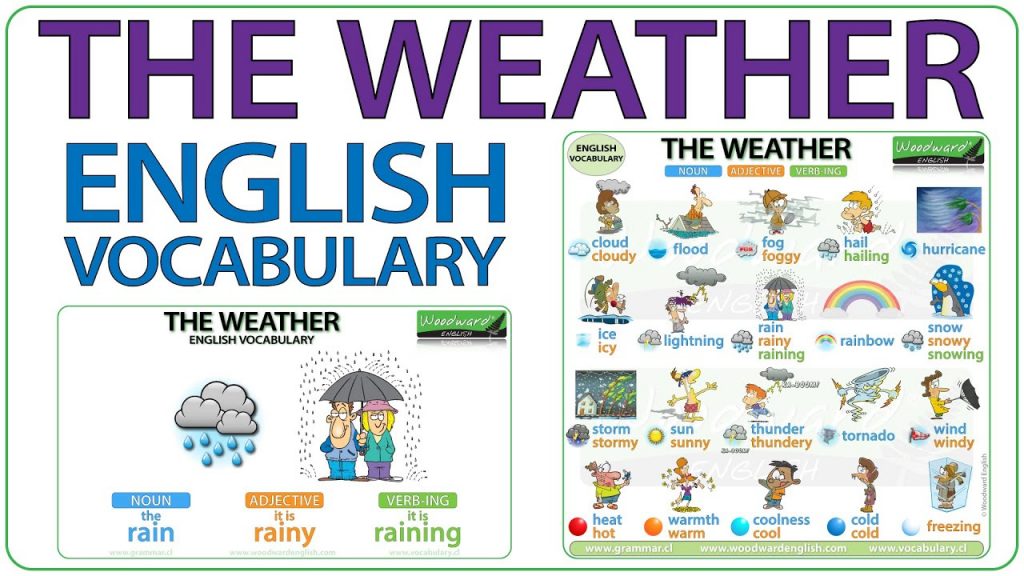
Talking about the weather
Apart from watching the video, we'll have a look at a quite complete list of vocabulary and expressions below. Click on the following LINK to access it.
MEANS OF TRANSPORT
Learn how to talk about transport and driving in English. What’s the best way to get around your hometown? Do you drive often? What public transport do you use regularly? Here, you’ll see how to answer these questions—and many others—in clear, correct English.
How do you get around your hometown? What are the advantages or disadvantages of different forms of transport where you live?
VERB TENSE REVIEW
Click on the image below to access the information about verb tenses that will help you understand and work on it easily.
![]() |
| Click to access the information |